The Telescope Design: EST features an on-axis Gregorian configuration with a 4.2-meter primary mirror. This optical design is specifically chosen to minimize instrumental polarization, which is crucial for measuring the Sun’s magnetic fields accurately.
- Multi-Conjugate Adaptive Optics (MCAO): To counter the turbulence of Earth’s atmosphere, EST is equipped with a Multi-Conjugate Adaptive Optics (MCAO) system. This integrates deformable mirrors into the telescope’s optical path, correcting blurring in real-time and providing sharp images across a wide field of view.
- Heat Rejection: Observing the Sun with large telescopes concentrates massive amounts of heat. EST utilizes a specialized heat rejector at the prime focus to safely remove the excess solar energy while allowing the scientific light to pass through.
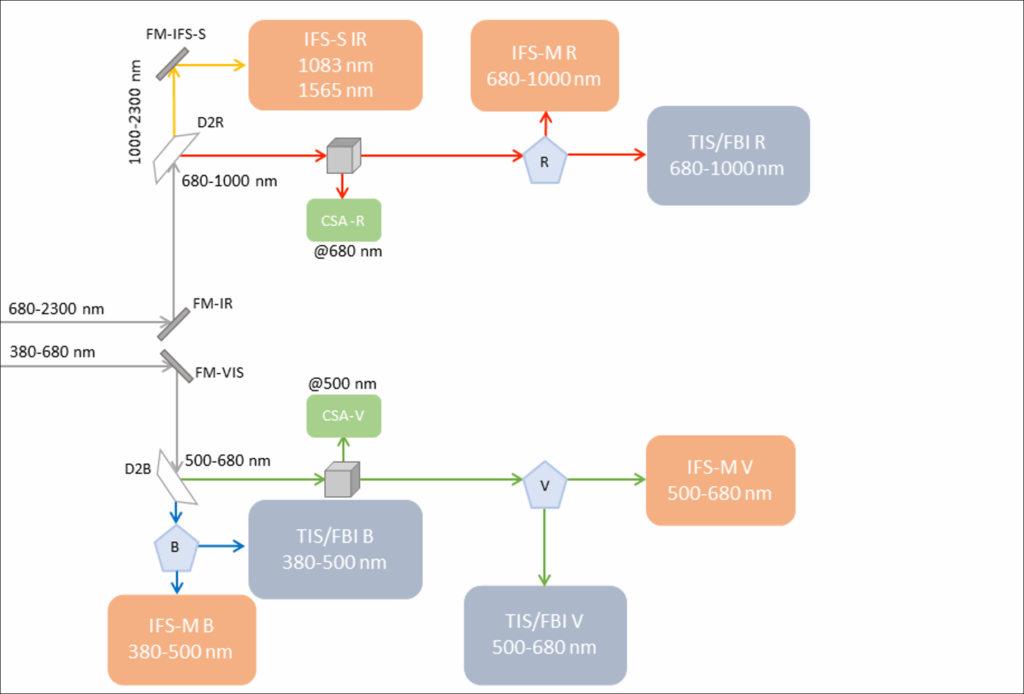
Instrumentation: The EST instrumentation suite is designed for “multi-wavelength” observations. This means the telescope distributes light to several instruments simultaneously, allowing for observations of different layers of the solar atmosphere at the exact same moment. Key instrument capabilities include:
- Tunable Imaging Spectropolarimeters (TIS): For high-speed mapping of magnetic fields.
- Integral Field Spectrographs (IFS) combined with Fast Broad-band Imagers (FBI): For detailed 3D spectral analysis of small rapidly-evolving solar features.
- Broad Spectral Coverage: Ranging from the near-ultraviolet to the near-infrared.
The light distribution between these instruments is shown in the picture below. Further details can be found at the EST website.